What's the difference between Portuguese farturas and Spanish churros? The shape, the dough, the origin, and where to eat both in Lisbon.
Farturas vs Churros: The Difference, and Where to Eat Both
If you grew up in Portugal, you probably ate farturas long before you knew what a churro was. If you're Spanish, it happened the other way round. And if you're visiting, there's a good chance you think they're the same thing.
They aren't — and the difference comes down to three things: the shape, the dough, and what they're eaten with.
The shape
A fartura is thick and coiled in a spiral. It's fried as one continuous spiral and then cut into lengths, which means a fartura can be as long as you want it. It has wide ridges and a soft, almost cake-like interior.
A Spanish churro is thinner and shorter, with sharper ridges and a different ratio of crust to centre: less dough inside, more fried surface outside. It's the shape you hold between two fingers and dip.
That's the difference you can see. The one you taste comes next.
The dough
Both start from something simple — flour, water, salt — but handled differently. Fartura dough is usually richer and softer, built to survive the thicker shape without staying raw in the middle. Churro dough is firmer, made to fry fast and come out crisp.
The practical result: a fartura is satisfying on its own; a churro asks for something alongside it.
What they're eaten with
This is where the line becomes clearest.
The Portuguese fartura lives with sugar and cinnamon, dusted on while it's still hot. Sweet, dry, and made to be eaten walking.
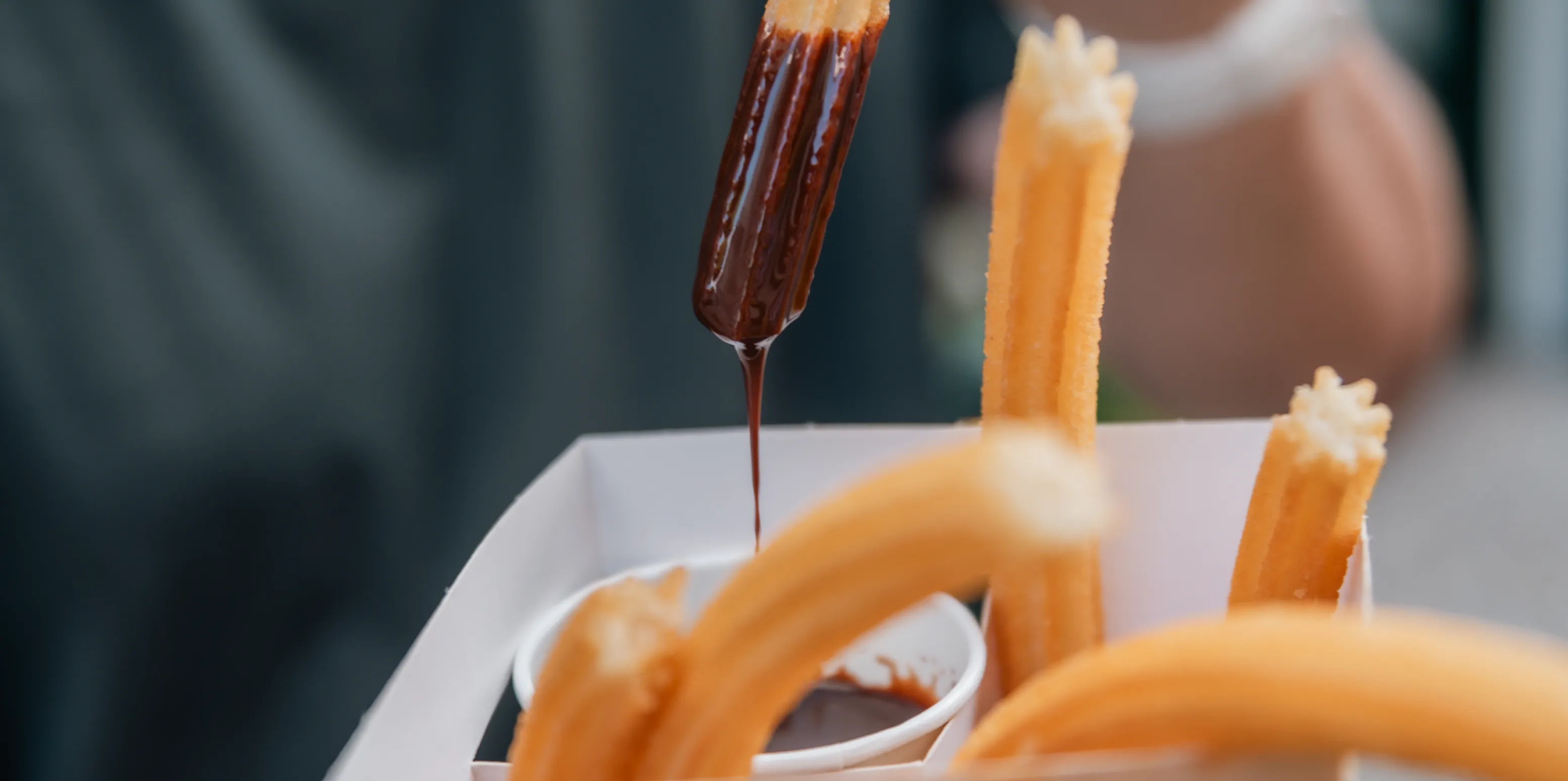
The Spanish churro lives with thick hot chocolate — not a chocolate for drinking, a chocolate for dipping. Dense enough to hold a spoon upright. Eaten sitting down, slowly, usually at breakfast or in the late afternoon.
Where they come from
The churro is Spanish and centuries old, associated above all with Madrid and the ritual of eating them in the small hours. [Chocolatería San Ginés](/churros-lisbon) opened in Madrid in 1894 built around exactly that habit.
The fartura arrived in Portugal and settled into a different context: fairs, street festivals, the summer santos populares. It isn't home food or café food — it's festival food. That's why most people in Portugal associate farturas with summer, the smell of frying in the evening air, and a queue after dark.
Which is better?
Entirely depends on what you want in the moment.
Choose farturas if: you want something sweet to eat in your hand, you like sugar and cinnamon, or you want the flavour that's familiar from childhood.
Choose churros if: you want to sit down, you want chocolate, or you want the version that exists to be dipped.
If you can't decide, the sensible answer is to try both side by side. It's the only way to understand that the difference isn't a detail.
Where to eat farturas and churros in Lisbon
Outside fair season, finding farturas in Lisbon is harder than you'd expect. Finding one place that serves farturas and churros made to order is rarer still.
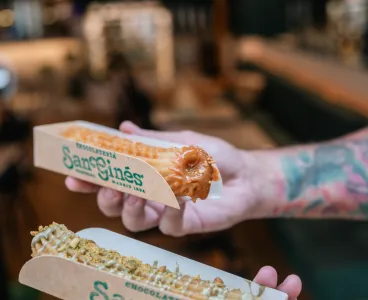
In Cais do Sodré, on Travessa de São Paulo, Chocolatería San Ginés serves both. One portion means six churros or two farturas, and the same chocolate — the Madrid recipe since 1894, made by hand daily — comes with either.
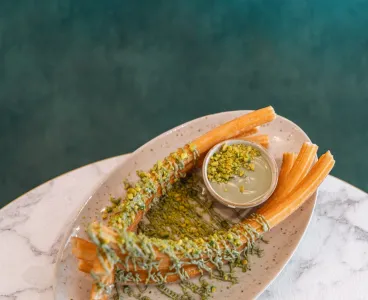
There are also filled churros in caramel, Nutella, Oreo and pistachio, plus a sharing size, the family churro.
How to order
- First time: a portion of churros with the classic chocolate. It's the basic test, and it tells you what a place is worth.
- If you have a sweet tooth: the XL chocolate, 300 ml with whipped cream.
- To share: the family churro, or the combo with a jug of chocolate.
- To try something different: the pistachio churro, the newest version and the one most people are asking for now.
Worth knowing
The thick chocolate isn't a presentation flourish — it's functional. A thin chocolate runs off the churro before it reaches your mouth. The density exists to cling. If someone serves you watery hot chocolate with churros, you're eating two things that weren't made for each other.
Which is why you judge a place by its chocolate, not by its churro. Any kitchen can manage a churro. Chocolate that holds a spoon upright is a recipe kept for generations or not held at all.
Where to go, specifically
Chocolatería San Ginés — Travessa de São Paulo 9-11, Cais do Sodré, Lisbon.
Open in Madrid since 1894, in Lisbon more recently, with the same chocolate recipe made by hand every day. It's the one place where you can try farturas and churros side by side and decide for yourself.
[See the full menu and opening hours.](/churros-lisbon)
---
*Read also: [the best desserts in Lisbon](/best-desserts-lisbon) and [pistachio desserts in Lisbon](/pistachio-desserts-lisbon).*
Últimas noticias